"The leisure time of most men numbs them: activity drives them mad."- Epicurus, 5th Vatican Saying
Let me just put a big disclaimer here at the beginning of this piece: I'm no puritan. In fact, by the standards of many folks, I'm probably quite the deviant: Atheist. Welfare state liberal.Overweight. Casual drinker. Probably around a 2 on the Kinsey Scale. A Woody Allen fan.
Any one of those things are enough to get me burned at the stake in certain states. All of them put together limit my choices of residency considerably.
So, when I talk about the ways in which a person might prefer to spend their off time, don't think I'm coming at you like I just stepped off the Mayflower.
The truth is, this Vatican saying stings me a little bit, because I realize that in many cases, I'm the guy Epicurus is talking about.
While I'm not a glutton when it comes to food, I think I'm something a little bit worse; I don't overeat because I just can't get enough of a good thing, I overeat because--for some reason--I have a blind urge to consume. I am the same way with information. I take in way too much of it. I don't know why. The same demon that drives me to Wendy's to get a frosty after work also drives me to hit up Wikipedia at least a handful of times a day.
And so it goes for so many of our modes of unwinding: drinking and using drugs to excess, meaningless sexual encounters, time wasted on our knees in church, or standing in line at the buffet, ready to load up that plate a second time...
Do Americans suck at downtime because we have too much of it and are spoiled, or is it because the phrase 'Welfare State' is still considered a curse word in much of the country, and the concepts of self-maintenance and certain things being 'ends unto themselves' are completely foreign to us?
I don't know the answer to this question, but I am aware that I could probably benefit from doing a few crunches.
Hmm. I wonder what Wikipedia has to say about that.
Wednesday, March 9, 2011
Sunday, March 6, 2011
Bacon Bits# 1
Abby and I drove separately to the gym today, so I could head to work right after we were finished. Abby took the kids with her, and as they passed me on the road we waved at each other. Abby called me a minute later and told me that as we passed each other Jack said, "I like him". That made my day.
I like you too, Jackie.
I like you too, Jackie.
Thursday, March 3, 2011
Parking In Cincinnati

Dear Sir,
We received your letter wherein you apologized for failing to pay for your space at one of our parking lots. We appreciate that you are new to the city and that it didn't occur to you that you might have to pay to park, but we will unfortunately have to enforce the parking fee.
Failure to pay will result in your car being impounded, and the fee will still be owed.
Welcome to Cincinnati!
Sincerely,
Over and Above Parking Company
*
Dear Sir,
We received your letter stating that you paid for parking, yet didn't realize that you also needed to place your parking ticket visibly on the dashboard of the car. While we see from our records that it is true that you did pay the fee, we will still have to fine you for not leaving the parking receipt visibly on the dashboard of your car.
Failure to pay will result in your car being impounded, and the fee will still be owed.
Sincerely,
Over and Above Parking
*
Dear Sir,
We received your letter stating that you paid for parking, and that you placed your parking receipt visibly on your dashboard. Unfortunately, you did not fold your parking receipt into the pre-requisite origami swan that is specified on the meter instructions. We see that you did indeed attempt to fold your receipt into the pre-requisite swan, but--after passing the receipt around the office and looking at it from several different angles and in different kinds of light--the general consensus is that it looks more like a duck than a swan, and we will--unfortunately--have to enforce the parking fee.
Failure to pay will result in your car being impounded, and the fee will still be owed.
We appreciate your business, and hope you will continue to choose to park with our company in the future!
Sincerely,
Over and Above Parking
Wednesday, March 2, 2011
Wednesday, February 23, 2011
Drinking The Mortal Brew: You Can't Always Get What You Want


"Necessity is an evil; but there is no necessity for continuing to live subject to necessity." -Epicurus, Third Vatican Saying
As Mick Jagger so wisely observes: 'You can't always get what you want, but if you try, sometimes you might find you get what you need'.
Often, what we need is to realize that we never needed what we thought we did to begin with. One of the important concepts of Epicureanism is to reduce your desire down to its basic components so that there's less stuff out there to be enslaved to, and thus, less stuff to need. By having our false needs thwarted, we discover our real ones.
Thank you Mick Jagger, for being a good Epicurean.
I am lucky to have very few regrets in my life (so far! there is always time to add to the collection...). There are plenty of things I wish I had never said, or wish I had said differently. There are a few people that have passed through my life that I wish I had been more helpful to. But these regrets are common; I am an imperfect animal, and can't expect to always live up to my full potential. Such is life.
But let me tell you about two different ways in which I have encountered the truth of this Vatican saying. Both pertain to regret.
For years, I fantasized about becoming rich and famous. Rich and famous as a baseball player (ages 9-14), rich and famous as a rock musician (ages 14-18), rich and famous as a stand up comedian (ages 18-19), and, finally, rich and famous as a writer (ages 19 to, oh, about 25). I'm 29 now, and I have spent most of my life fantasizing about that winning lottery ticket. The rich part is easy to explain. Becoming independently wealthy provides an individual (to paraphrase John Updike) an escape hatch out of the need to be A PRODUCTIVE MEMBER OF SOCIETY. As a person with a mild authority complex and a strong desire to do whatever I feel like doing, working a little harder on the front end so I could escape on the back end (or perhaps halfway through) was very appealing. The famous aspect of it...I'm a little embarrassed to admit that I have spent most of my life needing loads of outside validation. I have gotten better at validating myself (or 'carrying my happiness around on the inside' as I often phrase it), but that's the case. Insecurity + Aimless creativity + Desire to not become the kind of guy George Carlin spent his life making fun of = my artistic ambitions.
That shit made me miserable. Of all the artistic parachutes I've fashioned for myself, writing turned out to be the one I liked the best, and it's the one that I start to feel shitty about if I don't do it often enough. It clears things out, it's fun, and I'm pretty good at it. But until I came to terms with the fact that it would probably only ever be an outlet and hobby-horse to ride, it caused me anxiety.
I needed to get published. I needed to write a book. I needed to be paid for my work. At first, so that I could get the validation (and money) that I needed to function the way I wanted to. But as I discovered how wonderful it was to have a family, I incorporated them into my escape fantasy. We would all get out.
But the fantasy wore on me. I became disillusioned with it, and kind of burnt out. I kept writing though. Even though I had given up the fantasy, I kept writing. I think the best analogy would be to someone who realized they were unable to lose weight, yet kept working out. I laughed at myself for a minute, but then I realized that writing had become an end unto itself for me. Writing makes me happy, so I do it. As Banksy so aptly put it, 'You don't go to a restaurant and order a meal because you want to have a shit'.
Blogging, I have discovered, is even better, because it comes with the opportunity to exchange ideas and form relationships with people you otherwise would have never met, and it can be done as much (or as little) as you would like, at your own leisure.
What's better is that I've abandoned my escape fantasy too. I am fully intent to live the life of a family man (I think I'm a good one), read books,cook, write blogs, hang out with my family, play the occasional game of racquetball, and work at a homeless shelter. It's not a bad life. It's not what I have spent most of my adolescent and adult life thinking was necessary, but then, I am not required to gratify fanciful necessities.
the second way in which I encounter the truth of this saying comes to me courtesy of my appetite. I have a very weak will when it comes to the more sensual pleasures. Eating especially. Doughnuts are very hard for me to resist. The saying that alcoholics use that 'one drink is just right, two is too many, and three is never enough' could be applied to me and doughnuts. I know that I don't need them. I lust after them, however, and usually hate myself about halfway through one. God forbid I get to a second one! The guilt that I feel about my relationship to sweet pastries must be very similar to the kind of guilt an addict or adulterer has after engaging in their misdeeds. I go to the gym, I drink lots of water, but goddammit, the doughnuts have me by the balls. I regret this aspect of my personality, and see how it enslaves me.
So, we can see the wisdom in this little nugget: make the target area smaller, and it will be harder to hit. If pleasure is the ultimate good, overindulgence is surely the biggest perversion one can indulge in. All of the fundamentalists and fanatics will tell you 'THOU SHALT NOT!', but Epicurus just says, 'hey, take it easy'.
you knew this was coming:
Monday, February 21, 2011
Little Troxell's Tattoo Parlour
My boys were drawing tattoos on each other with a big black sharpie the other day. doing tattoo work is a respectable way to make a living. If they want to go that way, they might as well start practicing now.


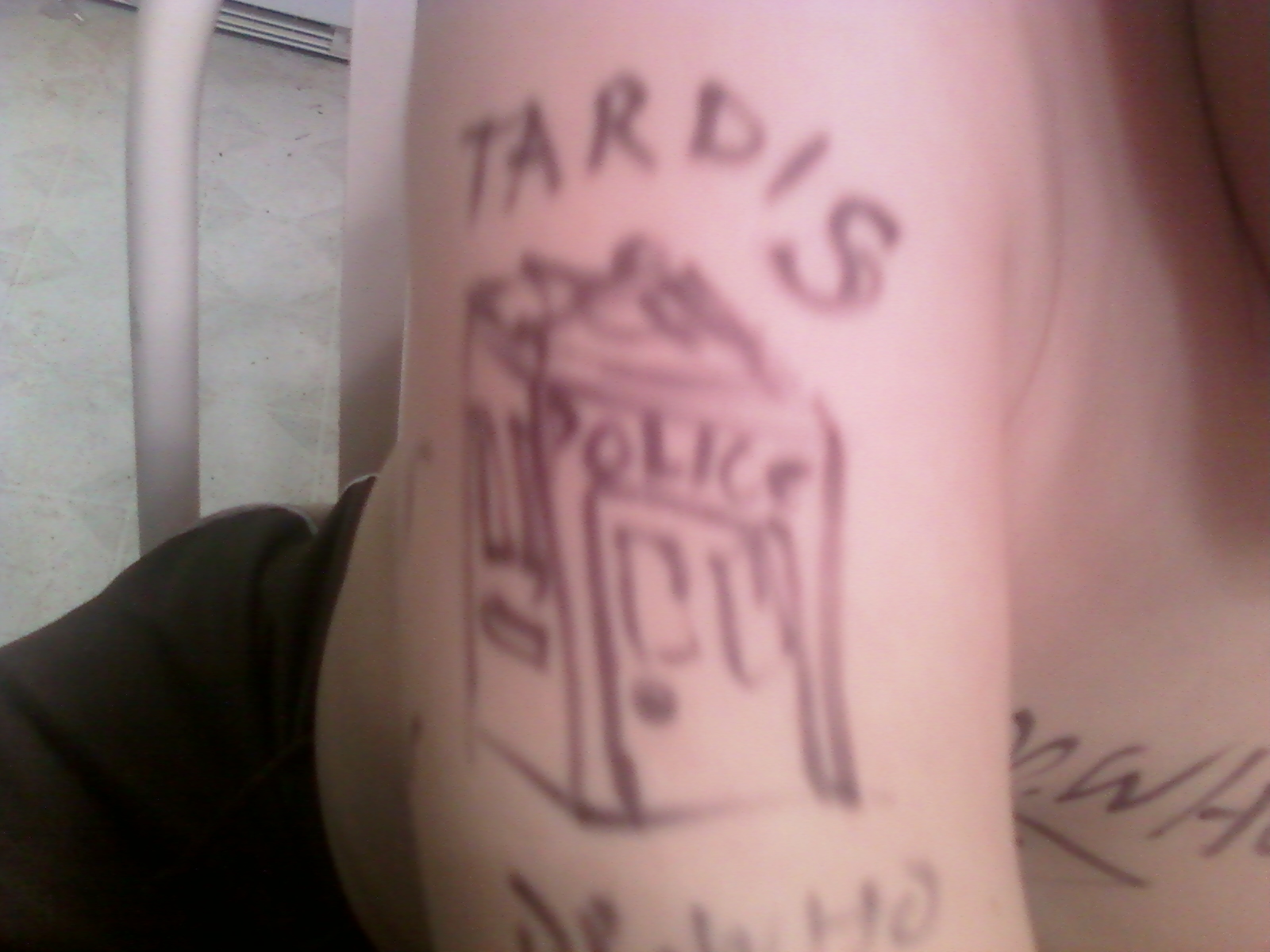
Wednesday, February 16, 2011
It's Worse Than You Thought! (Confessions of a Woody Allen fan)

I am an 'out' atheist and welfare state liberal living in conservative Cincinnati. Yet these are not the most controversial aspects of my identity.
The most controversial aspect of my identity--if measured purely by response--is that I am an enormous (enormous!) Woody Allen fan. The expressions of disbelief and quick condemnation cuts across religious and political divides. Almost universally, my character clearly becomes questionable to many who learn this factoid about me, and, frankly, it leaves me jejune.
The objection is almost always couched in disapproval of Woody Allen's 'lifestyle', i.e., his marriage to Soon Yi Previn. If it's the age discrepancy, I'll tell you that my favorite uncle--and one of the nicest and most moral men I've ever met--was thirty when he married my aunt, and she was thirteen. He died recently, and I'm not kidding when I say that theirs was a noble and inspiring love story. If the objection is to the fact he married his girlfriend's foster child, all I can say is that I don't know enough about the context of their relationship to judge it.
The controversy doesn't stop there: I am even more controversial among my fellow Woody Allen fans, because I rank some of his most recent work among his best.
It's popular for folks to opine Woody Allen's most recent work, and to long for the days of Annie Hall. While I agree that Annie Hall is a great movie (among his undisputed movies, I watch Annie Hall, Hannah and Her Sisters, Manhattan, and Crimes & Misdemeanors about 10 times a year each), I think Vicky Cristina Barcelona, Match Point, Whatever Works, Cassandra's Dream, and Melinda & Melinda are just as good, and I revisit them almost as frequently.
There have been duds, sure; Scoop, The Curse of the Jade Scorpion, and Hollywood Ending come to mind right away, but I would say that since Anything Else, Woody Allen's been on a roll.
His humor is as clear as ever, and his perspective has remained unique. I love the characters and the plots of his films. I love the dialogue, and appreciate his general approach to philosophy. Folks who are not offended by the fact that I admire the work of a man who married his girlfriend's adopted daughter are invariably thrown into a state of shock when I tell them I think Vicky Cristina Barcelona is just as good as Annie Hall.
When I am sick, or when I am in a rut, I can count on a Woody Allen film to put me back on track. When I tried to be a stand up comedian the summer after high school ended, I spent a lot of time reading Without Feathers and Getting Even (maybe that contributed to my failure as a stand-up, but it was my point of reference).
Not only is Woody Allen great, but he turned me on to jazz music and Humphrey Bogart too.
So, burn me at the stake. I have committed the excusable sins of atheism and liberalism, but alas, I am a Woody Allen fan in Cincinnati (and a deviant among Woody Allen fans to boot!). I can't renounce my crime, and I don't want to.
Why?
"Because it is my name! Because I cannot have another in my life! Because I lie and sign myself to lies! Because I am not worth the dust on the feet of them that hang! How may I live without my name? I have given you my soul; leave me my name!" -from The Crucible.
Sunday, February 13, 2011
Drinking the Mortal Brew: Run On for a Long Time...
this is part of a series I am writing on Epicurus's Vatican Sayings. To view other parts of the series, click here.
"It is difficult for a wrongdoer to go undetected; to remain assured that he will go undetected is impossible"- Epicurus, 2nd Vatican Saying
"What is done in the dark will be brought to the light". "The truth will out". "A wrong visited on another will be visited on the perpetrator three times over".
The theme that we all 'get what is coming to us' is very popular, and very comforting (to a certain extent). It's what gives some of us hope, but it's also what causes some of us to bite our fingernails.
But I don't believe in karma, and Epicurus didn't either. The beauty of this Vatican Saying is that it's not a promise of some kind of karmic woo-woo, but a practical observation: 'Yeah', it says, 'there's a chance you will get away with whatever it is you have done wrong, but if you do wrong, you have to live with the possibility that someday your deed may be uncovered'.
It doesn't say that the wrong will be uncovered. It says that it might. Once you act in bad faith, you must be ever vigilant that your transgression isn't discovered, and that you've always got the script--rationalizations you offer your self and others to justify your actions if they ever need justifying--down. Just on a meat-and-potatoes level, doing wrong is an exhausting prospect.
Belief in the inevitability of justice is bad for the same reasons that belief in saints is bad. The idea that 'someone else will take care of it' is the lazy road to apathy and inaction. Once you have been consigned to hell or promised heaven, everything in between is just filler. The brilliance of Epicurus's observation is not that it promises justice: it's brilliance lies in the understanding that a) in the end, sinning requires far too much work, and b) it's harder to reconcile yourself with a crime that you may not ever get convicted of than it is to receive a deserved sentence.
So, all ye evildoers, remember the exasperated refrain of the killer from Poe's 'Tell-Tale Heart' as he boards the bus to crazy town: "...it is the beating, the beating of his hideous heart!".
Who needs a hell in the afterlife when we are perfectly willing (and able) to construct private ones for ourselves, here on earth?
"What is done in the dark will be brought to the light". "The truth will out". "A wrong visited on another will be visited on the perpetrator three times over".
The theme that we all 'get what is coming to us' is very popular, and very comforting (to a certain extent). It's what gives some of us hope, but it's also what causes some of us to bite our fingernails.
But I don't believe in karma, and Epicurus didn't either. The beauty of this Vatican Saying is that it's not a promise of some kind of karmic woo-woo, but a practical observation: 'Yeah', it says, 'there's a chance you will get away with whatever it is you have done wrong, but if you do wrong, you have to live with the possibility that someday your deed may be uncovered'.
It doesn't say that the wrong will be uncovered. It says that it might. Once you act in bad faith, you must be ever vigilant that your transgression isn't discovered, and that you've always got the script--rationalizations you offer your self and others to justify your actions if they ever need justifying--down. Just on a meat-and-potatoes level, doing wrong is an exhausting prospect.
Belief in the inevitability of justice is bad for the same reasons that belief in saints is bad. The idea that 'someone else will take care of it' is the lazy road to apathy and inaction. Once you have been consigned to hell or promised heaven, everything in between is just filler. The brilliance of Epicurus's observation is not that it promises justice: it's brilliance lies in the understanding that a) in the end, sinning requires far too much work, and b) it's harder to reconcile yourself with a crime that you may not ever get convicted of than it is to receive a deserved sentence.
So, all ye evildoers, remember the exasperated refrain of the killer from Poe's 'Tell-Tale Heart' as he boards the bus to crazy town: "...it is the beating, the beating of his hideous heart!".
Who needs a hell in the afterlife when we are perfectly willing (and able) to construct private ones for ourselves, here on earth?
Thursday, February 10, 2011
Drinking The Mortal Brew: Send the Pain Below
[this is the first part of a series I am writing on The Vatican Sayings Of Epicurus. For the introduction to the series, click here.]
"All bodily suffering is negligible: for that which causes acute pain has short duration, and that which endures long in the flesh causes but mild pain." Epicurus, 1st Vatican Saying.
Anyone who has decided to skip that after-work martini or that second slice of pizza knows the truth in (at least) the second part of this saying. I certainly do: there are certain kinds of appetites that invite a dull ache into our lives simply by our acquisition of them. The mild pain that is caused by the absence of any of life's various narcotics is one of the underlying themes of this blog; it's also something that can be lived with if it is understood.
Desire can cause mild pain, but sometimes it's a pleasant ache: I look forward to seeing my kids at the end of the day. I look forward to asking my wife how her day was, and I look forward to laying in bed and reading a book before I fall asleep.
There are other kinds of mild pains that are pleasant: there is an anticipatory ache during sexual encounters that is profoundly pleasant. Aches for familiar people and scenery, and aches for food and drink* can also make the reward of finally experiencing them heightened and satisfying.
There are other kinds of mild pains that are tolerable. Epicurus--who struggled with chronic disease for his whole life--must have been a master of this subject. As a person who suffers from ulcerative colitis, I also am aware of pains that can be put up with. I often have a vague string of pain that climbs up my intestine, and due to often being anemic from my condition, I experience bouts of fatigue. Sometimes it's necessary for me to work through them in order to find a greater pleasure. Sometimes they have to be indulged, and I can find pleasure lying in bed too. Constantly pursuing peak highs with no lows will make you miserable. I've discovered that--at least for me--it's important to be something of a connoisseur of experiences: there are subtle shades and bright colors, and all can be appreciated for what they are, and if they cannot be appreciated, they can (at least in some cases) be endured. Suffering is part of life, and like all parts of our life, we must have a meaningful relationship with it.
This brings me to the subject of acute pain brought up in the first part of this post. I spoke to a young man the other day who suffers from bipolar disorder. He was deeply upset about a mistake that was made by the social security office that might end up affecting his housing options. He was off his medication, and was visibly very disturbed. Although he began by talking about throwing himself in front of a bus, and punching a table that sat between us, the act of talking through his predicament calmed him down.
Now, even as a person who does not have bipolar disorder, I can understand the anxiety that must accompany such a situation. Clearly, talking helped him navigate his feelings, just as talking often helps me; but as someone who has never experience mental illness, extreme disease (like cancer), or the tragic loss of a close family member, I feel uncomfortable talking with certainty about the endurability of certain forms of acute pain.
I do have guiding lights I can look to in this matter, however, who seem to validate Epicurus's thoughts on the survival of acute suffering.
Malcolm Varner is a person who blogs about his own experience with mental illness, and the various ways in which a person suffering with bouts of what I can only refer to as 'dark nights of the soul' can thrive. I have experienced despair, doubt, fear, and the whole range of human emotions. Yet I am conscious that folks who suffer from bipolar disorder and many other mental illnesses experience these emotions in much more acute ways than I am capable of conceiving. And many folks--like Malcolm--learn to constructively deal with them. This gives me solace.
And then there is Christopher Hitchens, who is not only dealing with stage four cancer with a bravery (and realism) that is utterly breathtaking and inspiring, but has managed to live a very admirable life after experiencing the great personal tragedy of losing his mother to suicide. I know it's risky to paraphrase Christopher Hitchens, but his decision to not 'move on' or heal after this event--he wants the wound of the suicide to remain because it is real, and is a kind of memorial to his mother--tells me that even if it cannot be overcome, acute pain can be survived, and possibly even transformed into a mild pain that can be integrated into who you are.
*The difference between the mild pain that is caused when you forgo that after-work martini or slice of pizza is worlds away from the mild (pleasant) pain of anticipating a nice glass of beer at a festival, or a plate of your mom's walnut chicken: one kind of ache is due to a desire to escape experience, and the other is due to a desire to fully inhabit an experience.
Monday, February 7, 2011
Drinking the Mortal Brew: Epicurus In the Medicine Cabinet
The philosopher I find myself going back to most often these days is Epicurus. His philosophy was at root simple and good, and I am at root a simple person (and I often try to be good).
Here are the basic precepts of Epicureanism, via Wikipedia:
I stumbled onto Epicurus while I was in high school. After reading a little bit of Anton Lavey--as all teenagers of a certain variety must--I discovered that there was much in his philosophy that seemed silly and gaudy, much that seemed stupid, and a strain of thought that was very appealing. The silly and gaudy stuff was the rituals and theatrical language. The stupid stuff was the Objectivism and Social Darwinism, and the appealing stuff was the Epicureanism, which didn't really seem to belong with those other things.
It has stayed with me. Decrease suffering, increase well-being. It seems like a simple calculus: Sometimes you forgo a trifling pleasure in order to earn the greater pleasure of self control and greater health. Enjoy the people you love. Be helpful to them. Don't make misery holy, and don't waste time storing up treasures in heaven; There are treasures all around us.
It's a good worldview in my estimation.
What I propose to do over the coming months is to dedicate at least one of my weekly posts to a meditation on one of Epicurus's Vatican sayings. It will be hardly academic.
The reason I am doing this is that I have found that when I look at the world through philosophical glasses, I am happier than when i am just lost in the barrage of events that is life. Writing about philosophy will--i hope--keep me focused.
Our lives are often very busy, and very hungry. It's important to remember that everything we desire may not be good for us, and that much of what we're busy at may be frivolous. I live in a (mostly) capitalist country, and am immersed in the culture of 'get some!'. I know it helps me to remember the following Epicurean advice:
“Do not spoil what you have by desiring what you have not; remember that what you now have was once among the things you only hoped for.”
Happiness is often only a perspective-shift away.
So, in short, if you don't enjoy watching strangers publicly masturbate, this blog may not be for you for a little while. If, however, that is your thing, grab a box of tissues and join my epicurean circle-jerk: the more the merrier.
read more here.

Here are the basic precepts of Epicureanism, via Wikipedia:
"Epicureanism is a system of philosophy based upon the teachings of Epicurus, founded around 307 BC. Epicurus was an atomic materialist, following in the steps of Democritus. His determinism led him to a general attack on superstition and divine intervention. Following Aristippus—about whom very little is known—Epicurus believed that the greatest good was to seek modest pleasures in order to attain a state of tranquility (ataraxia) and freedom from fear, as well as absence of bodily pain (aponia) through knowledge of the workings of the world and the limits of one's desires. The combination of these two states is supposed to constitute happiness in its highest form. Although Epicureanism is a form of hedonism, insofar as it declares pleasure as the sole intrinsic good, its conception of absence of pain as the greatest pleasure and its advocacy of a simple life make it different from "hedonism" as it is commonly understood."
I stumbled onto Epicurus while I was in high school. After reading a little bit of Anton Lavey--as all teenagers of a certain variety must--I discovered that there was much in his philosophy that seemed silly and gaudy, much that seemed stupid, and a strain of thought that was very appealing. The silly and gaudy stuff was the rituals and theatrical language. The stupid stuff was the Objectivism and Social Darwinism, and the appealing stuff was the Epicureanism, which didn't really seem to belong with those other things.
It has stayed with me. Decrease suffering, increase well-being. It seems like a simple calculus: Sometimes you forgo a trifling pleasure in order to earn the greater pleasure of self control and greater health. Enjoy the people you love. Be helpful to them. Don't make misery holy, and don't waste time storing up treasures in heaven; There are treasures all around us.
It's a good worldview in my estimation.
What I propose to do over the coming months is to dedicate at least one of my weekly posts to a meditation on one of Epicurus's Vatican sayings. It will be hardly academic.
The reason I am doing this is that I have found that when I look at the world through philosophical glasses, I am happier than when i am just lost in the barrage of events that is life. Writing about philosophy will--i hope--keep me focused.
Our lives are often very busy, and very hungry. It's important to remember that everything we desire may not be good for us, and that much of what we're busy at may be frivolous. I live in a (mostly) capitalist country, and am immersed in the culture of 'get some!'. I know it helps me to remember the following Epicurean advice:
“Do not spoil what you have by desiring what you have not; remember that what you now have was once among the things you only hoped for.”
Happiness is often only a perspective-shift away.
So, in short, if you don't enjoy watching strangers publicly masturbate, this blog may not be for you for a little while. If, however, that is your thing, grab a box of tissues and join my epicurean circle-jerk: the more the merrier.
read more here.

Thursday, February 3, 2011
Nerdiest State In The Union
Something I can be proud of my home state for:

(from Pleated Jeans, Via Why Evolution Is True.)
So, how did your state rank?

(from Pleated Jeans, Via Why Evolution Is True.)
So, how did your state rank?
Monday, January 31, 2011
Things I Like About The Republican Led House (so far)
I like the idea of reading the constitution before every session.
I like the idea of requiring each bill that is passed to demonstrate what area of the constitution sanctions it.
I also like John Boehner better than Nancy Pelosi. I disagree with some of Boehner's proposals, but he strikes me as a decent guy, and generally sincere in his political stances. It was touching the other night during the State Of the Union when he allowed himself to become emotional when President Obama paid tribute to his rise from 'sweeping floors in his father's Cincinnati shop' to speaker of the house.
I am often critical of republicans and republican ideas, so I wanted to make sure I wrote about a few points of agreement and approval.
Hopefully, I'll be able to add to this list quite a bit over the next few years.
I like the idea of requiring each bill that is passed to demonstrate what area of the constitution sanctions it.
I also like John Boehner better than Nancy Pelosi. I disagree with some of Boehner's proposals, but he strikes me as a decent guy, and generally sincere in his political stances. It was touching the other night during the State Of the Union when he allowed himself to become emotional when President Obama paid tribute to his rise from 'sweeping floors in his father's Cincinnati shop' to speaker of the house.
I am often critical of republicans and republican ideas, so I wanted to make sure I wrote about a few points of agreement and approval.
Hopefully, I'll be able to add to this list quite a bit over the next few years.
Thursday, January 27, 2011
You've Got to Keep It Sexy
My number 2 most popular post of all time, according to blogger's stats function, is the following image of my receding hairline:

Apparently, a lot of insecure guys google the term 'receding hairline', and end up at my page. I sympathize with this impulse (as you can see from the above photo). In the name of earning this post even more hits than the last one featuring my funky recess, here are a few more terms that insecure guys will flock to: penis size. back hair. love handles. Mariah Carey.
You know; whatever keeps'em coming back.
And just for the record: my first most popular post was a response I made to an itchy conservative dogmatist who challenged my claim that there was an underlying racial component to the tea party movement. Not only did I provide ample evidence in my rebuttal to him, I also provided one of his colleagues (or possibly him, using a pseudonym), one of the more unequivocal intellectual ass-kickings that I've had the pleasure of handing out since I've been a blogger. In order to encourage more google hits from folks like Bill Stevens, I offer the following searchable terms: Ronald Reagan in a wet t-shirt, gun porn, and, you're not racist if you went to high school with a black guy, right?
my third most popular post thus far has been a fairly recent one: 'How Atheism Led Me to Social Work'.
What do I learn from all of this, other than the fact that guys are worried about their hairlines, Saul Alinsky was right about the humorlessness of ideologues, and that atheism and social work are not two topics you typically find being addressed at the same time?
It's difficult to say, but I might sum it up this way: you've got to keep it sexy.
Apparently, a lot of insecure guys google the term 'receding hairline', and end up at my page. I sympathize with this impulse (as you can see from the above photo). In the name of earning this post even more hits than the last one featuring my funky recess, here are a few more terms that insecure guys will flock to: penis size. back hair. love handles. Mariah Carey.
You know; whatever keeps'em coming back.
And just for the record: my first most popular post was a response I made to an itchy conservative dogmatist who challenged my claim that there was an underlying racial component to the tea party movement. Not only did I provide ample evidence in my rebuttal to him, I also provided one of his colleagues (or possibly him, using a pseudonym), one of the more unequivocal intellectual ass-kickings that I've had the pleasure of handing out since I've been a blogger. In order to encourage more google hits from folks like Bill Stevens, I offer the following searchable terms: Ronald Reagan in a wet t-shirt, gun porn, and, you're not racist if you went to high school with a black guy, right?
my third most popular post thus far has been a fairly recent one: 'How Atheism Led Me to Social Work'.
What do I learn from all of this, other than the fact that guys are worried about their hairlines, Saul Alinsky was right about the humorlessness of ideologues, and that atheism and social work are not two topics you typically find being addressed at the same time?
It's difficult to say, but I might sum it up this way: you've got to keep it sexy.
Sunday, January 23, 2011
Are You Scared?
Laying in bed the other night, my wife and I talked about my movement away from religion. My wife, since I met her, had always held religion at something of a distance, and only engaged in church going to indulge me (I was pretty religious in the beginning). On the subject of God, she has consistently said she thinks there is something to it; on the subject of organized religion and the divinity of holy books, she has always been highly doubtful. If she is the middle, I have traveled from her far right, to her far left during the course of our marriage.
After a moment of silence, she asked me, 'Are you ever scared to say and write the things you do about religion?'
'No', I said after a second of consideration. 'I used to be sometimes, but not anymore'.
There was a time when I would worry--those 3am moments when you're the only one awake and your mind is flooded with 'what ifs'--but that time has passed. The religion I was raised around smelled vaguely of fire and brimstone. As I grew older, my religion became more liberal--more about 'thou shalt' than 'thou shalt not'--and God seemed more compassionate to me. Kurt Vonnegut's Jesus became my own eventually, and that Jesus wasn't here to condemn as much as he was to point the way. Once I tossed the whole thing out the window, I was pretty far removed from that easy-to-caricature, old-time-religion God anyway.
Strangely, part of the reason that I am not afraid of the reprisal of any possible god for my current unbelief is that I expect that a good god--the religious folk who would condemn me to hell as a heretic and atheist always say that their god is ultimately good--wouldn't punish me for my honest dissent. I find Christianity to be inherently immoral. I have known many, many, wonderful Christians, but my claim is not that it is their religion that makes them good. They are good. If they use their religion to express their goodness, that is fine, but I can't believe that they derive the source of their goodness from the holy bible, which is a mixed bag at best.
The other religions aren't even an option for me. I was raised in a Christian nation, surrounded by Christians. There is no chance that I would ever be tempted to internalize the myths of any other culture as literally true. I don't believe in any of the Gods that have been proposed to me, because of lack of evidence, lack of credibility, or both. I am not afraid of the reprisal of any of these possible gods because the gods that I have heard of have either been vindictive, snot-nosed little tyrants, or perfectly reasonable libertarians who seem to trust their creation to get on without too much intervention from them. There's no point in even trying to appease the first kind of god, and the second is already hip to' all that is the case'.
So, no, I'm not scared. I have too much faith for that.
After a moment of silence, she asked me, 'Are you ever scared to say and write the things you do about religion?'
'No', I said after a second of consideration. 'I used to be sometimes, but not anymore'.
There was a time when I would worry--those 3am moments when you're the only one awake and your mind is flooded with 'what ifs'--but that time has passed. The religion I was raised around smelled vaguely of fire and brimstone. As I grew older, my religion became more liberal--more about 'thou shalt' than 'thou shalt not'--and God seemed more compassionate to me. Kurt Vonnegut's Jesus became my own eventually, and that Jesus wasn't here to condemn as much as he was to point the way. Once I tossed the whole thing out the window, I was pretty far removed from that easy-to-caricature, old-time-religion God anyway.
Strangely, part of the reason that I am not afraid of the reprisal of any possible god for my current unbelief is that I expect that a good god--the religious folk who would condemn me to hell as a heretic and atheist always say that their god is ultimately good--wouldn't punish me for my honest dissent. I find Christianity to be inherently immoral. I have known many, many, wonderful Christians, but my claim is not that it is their religion that makes them good. They are good. If they use their religion to express their goodness, that is fine, but I can't believe that they derive the source of their goodness from the holy bible, which is a mixed bag at best.
The other religions aren't even an option for me. I was raised in a Christian nation, surrounded by Christians. There is no chance that I would ever be tempted to internalize the myths of any other culture as literally true. I don't believe in any of the Gods that have been proposed to me, because of lack of evidence, lack of credibility, or both. I am not afraid of the reprisal of any of these possible gods because the gods that I have heard of have either been vindictive, snot-nosed little tyrants, or perfectly reasonable libertarians who seem to trust their creation to get on without too much intervention from them. There's no point in even trying to appease the first kind of god, and the second is already hip to' all that is the case'.
So, no, I'm not scared. I have too much faith for that.
Thursday, January 20, 2011
Langston!
It just occurred to me that I haven't blogged about the newest arrival to our family yet.
Langston James Troxell, born December 20th:

So far, he's a pretty laid back baby. We've taken to calling him 'The Dude', because he only cries when he's hungry, or when he wants to be held, and then not very intensely.
Jack, our middle son, is very loving towards Langston, and spends a lot of time doting on him. Jack is a natural caretaker, and will be a very good big brother. He sings to Langston, throws away diapers for us, and spends a lot of time just looking at him, and laughing at the little baby faces he makes.
Spencer likes Langston too, although he is not as persistently interested in him as Jack is. He will hold Langston from time to time, and even walk around with him, but is mostly business-as-usual. He's a cerebral guy, and usually has his own thing going on. He's nine years older than Langston, and I expect him to be a good resource for Jack and Langston both when they (inevitably) find themselves not in the mood to talk to Abby or I about any of life's inevitable problems. Also, what better way to stay plugged into the zeitgeist than through a cool older brother?
Abby and I are very happy, and feel like our family is complete. For now...It has occurred to me that we're pretty good parents, and that family life is something that we both enjoy. So, I'm not opposed to swelling the brood a little bit more, at some future date.
Stay tuned.
Langston James Troxell, born December 20th:

(Langston, throwing a militant baby fist into the air)
Jack, our middle son, is very loving towards Langston, and spends a lot of time doting on him. Jack is a natural caretaker, and will be a very good big brother. He sings to Langston, throws away diapers for us, and spends a lot of time just looking at him, and laughing at the little baby faces he makes.
Spencer likes Langston too, although he is not as persistently interested in him as Jack is. He will hold Langston from time to time, and even walk around with him, but is mostly business-as-usual. He's a cerebral guy, and usually has his own thing going on. He's nine years older than Langston, and I expect him to be a good resource for Jack and Langston both when they (inevitably) find themselves not in the mood to talk to Abby or I about any of life's inevitable problems. Also, what better way to stay plugged into the zeitgeist than through a cool older brother?
Abby and I are very happy, and feel like our family is complete. For now...It has occurred to me that we're pretty good parents, and that family life is something that we both enjoy. So, I'm not opposed to swelling the brood a little bit more, at some future date.
Stay tuned.
Monday, January 17, 2011
How Atheism Led Me To Social Work
More often than not, when you ask a person in my field--I work in a homeless shelter--what motivated them to join up, it is reasonable to expect some variation on the following answer: I was called to it.
Without a doubt, the religious faith of folks in my line of work is a factor. Whether it was a person who has 'been there' and wanted to give back, or a person full of empathy and awareness of the shortcomings of our system, and got the little nudge that they needed from their respective church, mosque or synagogue, religious faith tends to motivate; That is wonderful, that is fine. We need as many good people as we can get, whatever the motivation (and there are many inspiring religious folk in this field: try to maintain a disdain for the faithful when you see all of the wonderful services the faithful offer in the homeless community; it's near impossible).
I offer my own testimony as both that of an interesting exception, and in the hopes that other secular folk might be inspired to get involved as well.
The spirit that led me to my current station was the realization that there was no other kingdom, and there was no greater glory to be found in the needless suffering of my fellow primates.Learning that there was probably no hereafter moderated many known (and unknown) masochistic tendencies I possessed in my religious life. To know that 'this is probably it' lit a fire under my ass to do something good with my life, to hell with treasures in heaven.
Homelessness offends me on different levels. On one level, I'm offended by the sheer callousness with which mankind can treat his fellows. In a society with a supposed safety net, an awful lot of people end up hitting the concrete pretty hard. I am also offended for selfish reasons. Isn't it obvious to everyone, that if you want yourself and the people you love to be safe and sound and free from the twin sins of want and ignorance, maybe it would be a good idea to make sure our neighbors are safe from them as well?
I feel a sense of urgency compelling me to try to contribute positively to our current (and only guaranteed) situation, and since I am able to do this kind of work, why shouldn't I?
Ideas have different effects on different people. Religion encouraged in me--as I believe it encourages in many people--an acceptance of suffering as part of god's plan, and--sickly--as a gift in some cases. As an atheist, I assure you that I don't look for divine meaning in the suffering of sentient beings. I look to find ways to minimize suffering for myself, and for others, and to maximize general well-being. I'm not working towards a utopia in the sky, or a utopia here on earth: I don't believe in either thing. I do believe in optimal states, however, and think that is an attainable goal worth working towards.
I have met many great people of faith working in this field. It's softened me, and has opened my mind to the possibilities of collaboration with people of different viewpoints and belief systems. Something that has saddened me, however, is how under-represented secular groups and individuals are in homeless service. This is something that I would very much like to see change. If you're an atheist, agnostic, non-theist, bright, or free-thinker, or have some connection to such a group, why not think of a way to volunteer in this field that could definitely use your time, money, and creativity?
cross posted at KOS.
Without a doubt, the religious faith of folks in my line of work is a factor. Whether it was a person who has 'been there' and wanted to give back, or a person full of empathy and awareness of the shortcomings of our system, and got the little nudge that they needed from their respective church, mosque or synagogue, religious faith tends to motivate; That is wonderful, that is fine. We need as many good people as we can get, whatever the motivation (and there are many inspiring religious folk in this field: try to maintain a disdain for the faithful when you see all of the wonderful services the faithful offer in the homeless community; it's near impossible).
I offer my own testimony as both that of an interesting exception, and in the hopes that other secular folk might be inspired to get involved as well.
The spirit that led me to my current station was the realization that there was no other kingdom, and there was no greater glory to be found in the needless suffering of my fellow primates.Learning that there was probably no hereafter moderated many known (and unknown) masochistic tendencies I possessed in my religious life. To know that 'this is probably it' lit a fire under my ass to do something good with my life, to hell with treasures in heaven.
Homelessness offends me on different levels. On one level, I'm offended by the sheer callousness with which mankind can treat his fellows. In a society with a supposed safety net, an awful lot of people end up hitting the concrete pretty hard. I am also offended for selfish reasons. Isn't it obvious to everyone, that if you want yourself and the people you love to be safe and sound and free from the twin sins of want and ignorance, maybe it would be a good idea to make sure our neighbors are safe from them as well?
I feel a sense of urgency compelling me to try to contribute positively to our current (and only guaranteed) situation, and since I am able to do this kind of work, why shouldn't I?
Ideas have different effects on different people. Religion encouraged in me--as I believe it encourages in many people--an acceptance of suffering as part of god's plan, and--sickly--as a gift in some cases. As an atheist, I assure you that I don't look for divine meaning in the suffering of sentient beings. I look to find ways to minimize suffering for myself, and for others, and to maximize general well-being. I'm not working towards a utopia in the sky, or a utopia here on earth: I don't believe in either thing. I do believe in optimal states, however, and think that is an attainable goal worth working towards.
I have met many great people of faith working in this field. It's softened me, and has opened my mind to the possibilities of collaboration with people of different viewpoints and belief systems. Something that has saddened me, however, is how under-represented secular groups and individuals are in homeless service. This is something that I would very much like to see change. If you're an atheist, agnostic, non-theist, bright, or free-thinker, or have some connection to such a group, why not think of a way to volunteer in this field that could definitely use your time, money, and creativity?
cross posted at KOS.
Thursday, January 13, 2011
Because I Have Spent All Of My Blogging Time This Week
discussing the social cause and effect of the recent events in Arizona with my blogger pals, I haven't had time to finish my planned Thursday essay. That essay, entitled 'How Atheism Led Me To Social Work', will now appear on Monday.
Until then, please enjoy this picture of quite possibly the cutest kitten ever:

And a song that is appropriate for any occasion:
And, finally, the coolest news story of the week:
NASA has found a giant, 'somehow living', green blob in outerspace. Awesome.
I'll see y'all on Monday.
Spencer
Until then, please enjoy this picture of quite possibly the cutest kitten ever:

And a song that is appropriate for any occasion:
And, finally, the coolest news story of the week:
NASA has found a giant, 'somehow living', green blob in outerspace. Awesome.
I'll see y'all on Monday.
Spencer
Wednesday, January 12, 2011
Andrew David King Weighs In
on the 'obligatory mudslinging' that has followed the crimes of Jared "in-dire-need-of-execution" Loughner.
excerpts:
and,
While I heartily endorse King's 'water the plant for once' point, I do have to disagree with him regarding the restriction of automatic weapon purchases. It's undeniable that we would probably have had a few less bodies on our hands if Loughner had needed to reload more often. More gun regulation may also have prevented someone with a sketchy past and mental health record like Loughner from purchasing these weapons in the first place...but then, if the laws regarding the confinement and treatment of mentally disturbed individuals weren't such in this country that a person almost needs to be in the middle of committing a horrendous act before they can be removed from the general population (or forced to receive treatment), maybe Loughner wouldn't have been able to buy any guns in the first place.
But the overall point--that many liberals are being just as reactive as members of what Bill Maher rightly calls 'The Pee Party' (tea party activists are always peeing their pants over some oversold 'threat to liberty')--is spot on, and needs to be heeded.
excerpts:
"But the point remains that it’s more a matter of readily available and early treatment for mentally unstable individuals like Loughner that’s needed–not further restrictions on the tools by which he committed the atrocity. You can keep chopping off all the dead leaves, or you can water the plant for once."
and,
"I don’t have any use for populist rage and witch-hunts, whether they’re of the Beck and Palin sort or the liberal sort, and neither do any other independent thinkers. Just because speech is offensive– or crass, or hateful–does not make it illegal. There is no constitutional right to never be offended, and for that we can thank the wisdom of the Founding Fathers, those supposed poster children for the Tea Party’s principles, for ensuring this holds true on both sides of the fence, regardless of what misguided journalists and pundits have to say."
While I heartily endorse King's 'water the plant for once' point, I do have to disagree with him regarding the restriction of automatic weapon purchases. It's undeniable that we would probably have had a few less bodies on our hands if Loughner had needed to reload more often. More gun regulation may also have prevented someone with a sketchy past and mental health record like Loughner from purchasing these weapons in the first place...but then, if the laws regarding the confinement and treatment of mentally disturbed individuals weren't such in this country that a person almost needs to be in the middle of committing a horrendous act before they can be removed from the general population (or forced to receive treatment), maybe Loughner wouldn't have been able to buy any guns in the first place.
But the overall point--that many liberals are being just as reactive as members of what Bill Maher rightly calls 'The Pee Party' (tea party activists are always peeing their pants over some oversold 'threat to liberty')--is spot on, and needs to be heeded.
Monday, January 10, 2011
What I Take Away From Saturday's Arizona Rampage
I vented my initial reaction to the shooting of Gabrielle Giffords on facebook:
Viscerally, this was satisfying. It's easy to look for scapegoats, and it's very easy to pin calamity on out-groups, especially when there's--at least--a loose connection. After sleeping on it however, this is where I'm at:
Even if it turns out that this lunatic was a huge Glenn Beck fan, I don’t think it’s appropriate to blame the tea party for this. Crazy, violent people will do crazy, violent things: if it wasn’t some weird ‘currency’ fixation, maybe a Katy Perry song would’ve done it.
If anything should be learned from this incident, it should be the following 3 things:
1) automatic weapons are way to easy to get a hold of in the U.S.
2) We need better mental health services in this country.
3) American students shouldn’t be able to leave high school without some training in psychology and critical thinking: If more members of our society were able to reason clearly, maybe fewer folks would be willing to offer up these ready-made John Birch fantasies for the mentally ill in our society to cling onto, and maybe there would be fewer folks out there ready to cling onto them.
There will be incidents like this in any society. The best thing to do is to figure out ways to make them happen as infrequently as possible.
'Alright, I've changed my mind on the border fence: I'll support it, just so long as it goes around Arizona too.'
Viscerally, this was satisfying. It's easy to look for scapegoats, and it's very easy to pin calamity on out-groups, especially when there's--at least--a loose connection. After sleeping on it however, this is where I'm at:
Even if it turns out that this lunatic was a huge Glenn Beck fan, I don’t think it’s appropriate to blame the tea party for this. Crazy, violent people will do crazy, violent things: if it wasn’t some weird ‘currency’ fixation, maybe a Katy Perry song would’ve done it.
If anything should be learned from this incident, it should be the following 3 things:
1) automatic weapons are way to easy to get a hold of in the U.S.
2) We need better mental health services in this country.
3) American students shouldn’t be able to leave high school without some training in psychology and critical thinking: If more members of our society were able to reason clearly, maybe fewer folks would be willing to offer up these ready-made John Birch fantasies for the mentally ill in our society to cling onto, and maybe there would be fewer folks out there ready to cling onto them.
There will be incidents like this in any society. The best thing to do is to figure out ways to make them happen as infrequently as possible.
Thursday, January 6, 2011
The Sound Of One Hand (In A Fashionable Leather Glove) Clapping
Spencer Troxell: So, the question remains: How many hats does a man need?
Lodo Grdzak: And what is the sound of one hand clapping?
So, that's like, what, seven?
My relationship with fashion has been very casual. In elementary school, I liked to wear t-shirts and underoos with my favorite cartoon characters on them. When I was in a church play in 5th grade, and all of the guys in the play went into the church locker room to change into our costumes--and I realized that I was the only person with the Tazmanian Devil on his underwear--I abruptly changed my style, and began to wear button up shirts more often, and plain old boxer shorts.
Then I read Jurassic Park in 6th grade, fell in love with the character of Ian Malcolm, and because of the following snippet of text, I decided to adopt his fashion philosophy:
Wearing all black and gray in middle school was both a boon and a curse: It was a boon in the sense that my decision to wear all black made it easier to make due with only a couple of pair of pants, t-shirts, and big black boots, and because (I thought) it made me look mysterious. My fashion choice also coincided with the rise of Goth-rock, so I became a de-facto member of that clique for awhile (until they realized that I was really just a big, happy-go-lucky nerd, and promplty ejected me).
My next conscious fashion decision came around mid-high school. There was a guy a year or two older than me named Dan Puckett that I thought was profoundly cool: he liked good music, and yet was popular. He had a distinct style of his own, and yet wasn't shunned by the herd. On top of all of these things, he seemed to like me, which was exceedingly rare among the cool kids. He liked to wear crazy, shiny shirts, and--hero-worshipper that I was--I decided to copy him. I don't know how much he minded being copycatted. I distinctly remember asking him one day whether or not he was going to change his style now that a handful of kids (I wasn't the only one) were copying him. His response: 'What, am I going to wear a fucking toga?'
I was still in the end stages of this style when I met my wife. She was a manager at a movie theater that I was working at. I purposefully made sure to wear each one of my five or six shiny shirts each time I came in to watch a free movie in the evenings that she worked, just to display my stylish versatility. She liked them--or at least she said she did because she liked me--and it encouraged me to buy more.
After we got married at the age of 19, I decided my attire needed to grow up a little bit. I began wearing white t-shirts and khakis a lot, and a lot of button up department store shirts. I was also--in an attempt to both elevate myself above other folks and find some kind of workable life philosophy--reading up on buddhism and aesthetic christianity, and thought the more plan look suited this more contemplative lifestyle. What we read and talk about is also part of our personal fashion.
Then I went to college, and stopped really paying attention to how I dressed too much. Function was key. I wore whatever clothes were in my closet, and didn't think too much about it. I stayed in the fashion desert for about 8 years; that's how long it took me to graduate.
Now, I'm graduated, and I find myself thinking about clothes more. I bought a derby, and have recently acquired a pretty nice trench coat and a nice pair of leather gloves. I wear vests, button up shirts and ties, and blue jeans a lot. My favorite footwear is a big, brown pair of wolverine boots. This ensemble may sound like it clashes, but I think it works for me.
I am paying more attention to the way I dress as I grow older. I don't think it's because I'm becoming shallower (although that could be the case), but I think it's because I'm feeling calmer. And more confident. I'm only twenty-nine. The frontal lobes are finished developing somewhere around the twenty-fifth year, so I'm only recently in possession of a complete brain. The hormones have calmed down, and most of the bodies that they left on the battlefield of my late teens and early twenties have been swept up and either buried, or ground up into decent summer sausages. Clothing is fun. Wearing a suit is fun. Because I am still a subversive at heart, the more dressed up I get, the more iconoclastic I feel: I am not someone who should be dressed respectably. Putting on a tie is like going undercover.
So, who knows how many hats a person should own? My guess is that you should either own none, or quite a few.
But that could just be my demon talking.
Lodo Grdzak: And what is the sound of one hand clapping?
So, that's like, what, seven?
My relationship with fashion has been very casual. In elementary school, I liked to wear t-shirts and underoos with my favorite cartoon characters on them. When I was in a church play in 5th grade, and all of the guys in the play went into the church locker room to change into our costumes--and I realized that I was the only person with the Tazmanian Devil on his underwear--I abruptly changed my style, and began to wear button up shirts more often, and plain old boxer shorts.
Then I read Jurassic Park in 6th grade, fell in love with the character of Ian Malcolm, and because of the following snippet of text, I decided to adopt his fashion philosophy:
"Ellie said, "Isn't it a little warm for black?"
You're extremely pretty, Dr. Sattler," he said. "I could look at your legs all day. But no, as a matter of fact, black is an excellent color for heat. If you remember your black-body radiation, black is actually best in heat. Efficient radiation. In any case, I wear only two colors, black and gray."
Ellie was staring at him, her mouth open. "These colors are appropriate for any occasion," Malcolm continued, and they go well together, should I mistakenly put on a pair of gray socks with my black trousers."
But don't you find it boring to wear only two colors?"
Not at all. I find it liberating. I believe my life has value, and I don't want to waste it thinking about clothing," Malcolm said. "I don't want to think about what I will wear in the morning. Truly, can you imagine anything more boring than fashion? Professional sports, perhaps. Grown men swatting little balls, while the rest of the world pays money to applaud. But, on the whole, I find fashion even more tedious than sports."
Dr. Malcolm," Hammond explained, "is a man of strong opinions."
And mad as a hatter," Malcolm said cheerfully. "But you must admit, these are nontrivial issues. We live in a world of frightful givens. It is given that you will behave like this, given that you will care about that. No one thinks about the givens. Isn't it amazing? In the information society, nobody thinks. We expected to banish paper, but we actually banished thought."
Wearing all black and gray in middle school was both a boon and a curse: It was a boon in the sense that my decision to wear all black made it easier to make due with only a couple of pair of pants, t-shirts, and big black boots, and because (I thought) it made me look mysterious. My fashion choice also coincided with the rise of Goth-rock, so I became a de-facto member of that clique for awhile (until they realized that I was really just a big, happy-go-lucky nerd, and promplty ejected me).
My next conscious fashion decision came around mid-high school. There was a guy a year or two older than me named Dan Puckett that I thought was profoundly cool: he liked good music, and yet was popular. He had a distinct style of his own, and yet wasn't shunned by the herd. On top of all of these things, he seemed to like me, which was exceedingly rare among the cool kids. He liked to wear crazy, shiny shirts, and--hero-worshipper that I was--I decided to copy him. I don't know how much he minded being copycatted. I distinctly remember asking him one day whether or not he was going to change his style now that a handful of kids (I wasn't the only one) were copying him. His response: 'What, am I going to wear a fucking toga?'
I was still in the end stages of this style when I met my wife. She was a manager at a movie theater that I was working at. I purposefully made sure to wear each one of my five or six shiny shirts each time I came in to watch a free movie in the evenings that she worked, just to display my stylish versatility. She liked them--or at least she said she did because she liked me--and it encouraged me to buy more.
After we got married at the age of 19, I decided my attire needed to grow up a little bit. I began wearing white t-shirts and khakis a lot, and a lot of button up department store shirts. I was also--in an attempt to both elevate myself above other folks and find some kind of workable life philosophy--reading up on buddhism and aesthetic christianity, and thought the more plan look suited this more contemplative lifestyle. What we read and talk about is also part of our personal fashion.
Then I went to college, and stopped really paying attention to how I dressed too much. Function was key. I wore whatever clothes were in my closet, and didn't think too much about it. I stayed in the fashion desert for about 8 years; that's how long it took me to graduate.
Now, I'm graduated, and I find myself thinking about clothes more. I bought a derby, and have recently acquired a pretty nice trench coat and a nice pair of leather gloves. I wear vests, button up shirts and ties, and blue jeans a lot. My favorite footwear is a big, brown pair of wolverine boots. This ensemble may sound like it clashes, but I think it works for me.
I am paying more attention to the way I dress as I grow older. I don't think it's because I'm becoming shallower (although that could be the case), but I think it's because I'm feeling calmer. And more confident. I'm only twenty-nine. The frontal lobes are finished developing somewhere around the twenty-fifth year, so I'm only recently in possession of a complete brain. The hormones have calmed down, and most of the bodies that they left on the battlefield of my late teens and early twenties have been swept up and either buried, or ground up into decent summer sausages. Clothing is fun. Wearing a suit is fun. Because I am still a subversive at heart, the more dressed up I get, the more iconoclastic I feel: I am not someone who should be dressed respectably. Putting on a tie is like going undercover.
So, who knows how many hats a person should own? My guess is that you should either own none, or quite a few.
But that could just be my demon talking.
Subscribe to:
Posts (Atom)